In insurance operations, integration tends to get most of the attention. Organizations invest in APIs, data exchange, automation, and platform strategy with the expectation that better connectivity will lead to smoother operations.
Those investments are important, but they rarely address the root cause of operational friction.
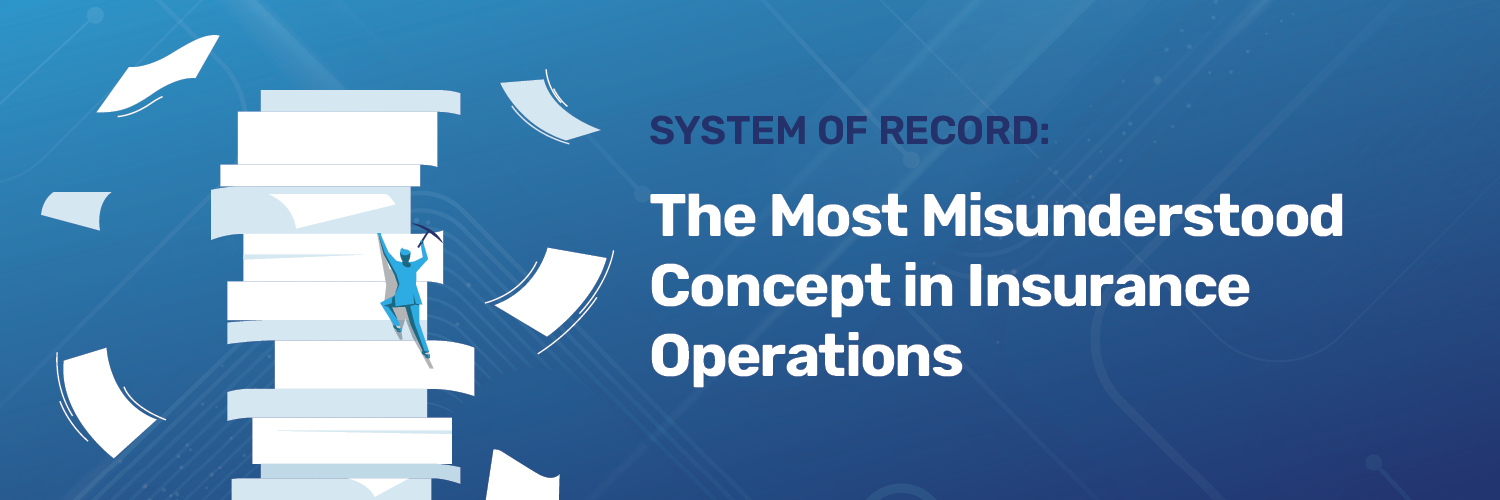
In practice, many of the issues that surface downstream can be traced back to a much simpler problem: no one clearly defined the system of record.
Without that clarity, even well-connected systems struggle to stay aligned.
What a System of Record Actually Means in Insurance Operations
A system of record is the authoritative source for a specific piece of data. It determines which system owns that data, how it should be used, and which version should be trusted when discrepancies appear.
That definition may seem straightforward, but in many organizations, it is either loosely defined or inconsistently applied.
When ownership is unclear, systems are left to interpret and overwrite each other’s data, creating confusion that carries through the entire process.
How Data Moves Across Enrollment, Payroll, and Carrier Systems
Data is constantly moving across the insurance ecosystem. Enrollment platforms pass elections downstream, payroll systems handle demographic data and deductions, and carrier systems maintain the official policy records. TPAs typically sit somewhere in the middle, depending on how the environment is structured.
This level of movement is expected. The complexity comes from how that data is governed as it moves between systems.
What Happens When System Ownership Isn’t Clearly Defined
When ownership has not been clearly established, inconsistencies begin to surface quickly.
An enrollment platform may show a completed benefit election while another system reflects missing information. Demographic updates made in payroll may be overwritten by outdated records elsewhere. Carrier systems may not align with what was submitted upstream.
Each of these situations requires manual intervention. Someone has to trace the data back to its source, determine which version is correct, and resolve the discrepancy before the process can continue.
Over time, this pattern becomes embedded in day-to-day operations. Teams begin to expect discrepancies and build workflows around resolving them rather than preventing them.
Why System of Record Is a Governance Decision, Not a Technical One
Insurance operations rely on a network of systems, vendors, and stakeholders that must remain aligned over time. In that environment, system-of-record decisions shape how the entire process functions.
Demographic data needs a clearly defined home. Plan elections and deduction logic need to be owned by a specific system.
Billing must be managed end-to-end within a single source.
These are governance decisions that determine how data flows, how conflicts are resolved, and how reliably the operation can scale.
When those decisions are not clearly defined, systems begin to work against each other rather than in coordination.
Why More Integration Doesn’t Solve Data Conflicts
When operational friction becomes visible, the natural response is to improve connectivity. Organizations often look to integrate additional systems or expand automation in an effort to reduce manual work.
Those efforts can improve efficiency, but they do not resolve underlying data conflicts when ownership remains unclear.
If two systems maintain different versions of the same data, increasing the speed of data exchange simply increases the speed at which inconsistencies appear. The issue is not connectivity; it is alignment.
How Data Conflicts Turn into Manual Work and Reconciliation Burden
As discrepancies accumulate, they create a growing operational burden.
Teams spend time reviewing reports, investigating mismatches, and reconciling records across systems. What begins as a minor upstream inconsistency often expands into downstream issues that affect billing, cash application, and reporting accuracy.
These activities require time, coordination, and repeated effort across teams. Because they are distributed throughout the organization, the full cost is not always visible, but it is consistently present.
The Hidden Cost of Letting Data Discrepancies Accumulate
When discrepancies are not addressed at their source, they tend to persist and grow over time.
Organizations may tolerate a certain level of variance, assuming it can be resolved later. In reality, that variance compounds and becomes more difficult to unwind.
The impact often becomes most visible during renewal cycles, audits, or client escalations. At that stage, resolving the issue requires more effort, introduces more risk, and places additional strain on client relationships.
What Changes When System Ownership Is Clearly Defined
When system-of-record ownership is clearly established, operations become more predictable.
There is less ambiguity around which system controls each data element, which reduces the likelihood of conflicting updates. Discrepancies are easier to identify, and resolution paths are more straightforward.
As a result, teams spend less time investigating issues and more time executing processes. Automation becomes more effective because it is supported by a stable data foundation rather than conflicting inputs.
The One Question That Determines Operational Clarity
The system of record is often discussed, but its impact is best understood through a simple question:
For each critical data element, which system owns it?
When that answer is clear, processes tend to operate more smoothly and consistently. When it is not, the resulting friction shows up across reconciliation, reporting, and client experience.
Establishing that clarity early creates a more stable and
efficient operating environment over time.